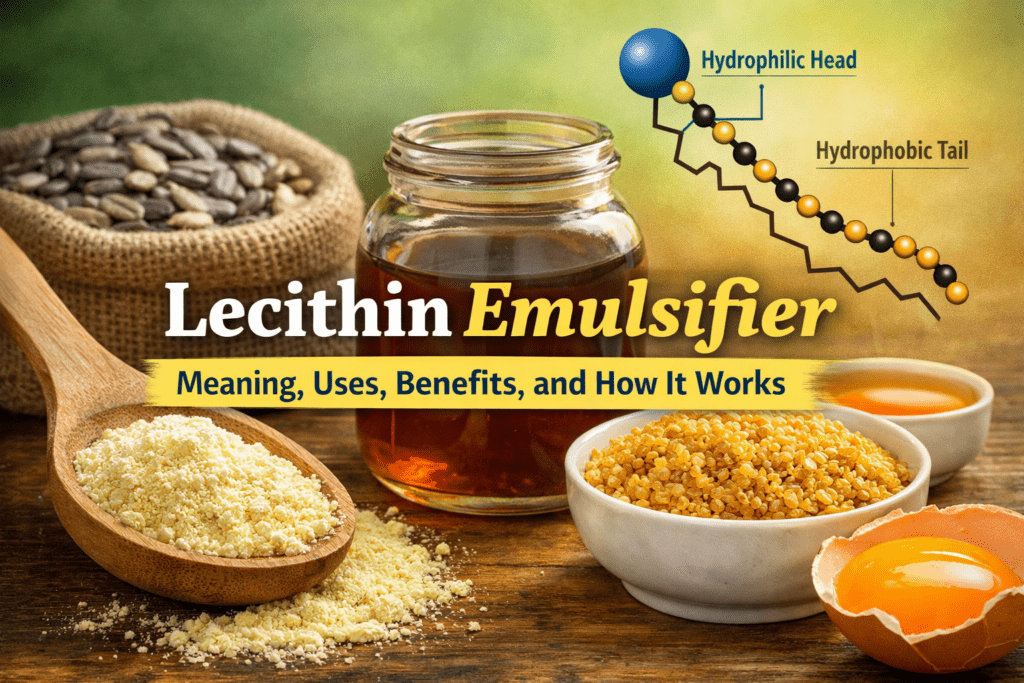
Introduction to Lecithin Emulsifier
Lecithin Emulsifier is a natural ingredient widely used across the food, pharmaceutical, and cosmetic industries. Its main role is to help mix substances that normally don’t blend well—especially oil and water. Since oil and water naturally separate, manufacturers rely on emulsifiers like Lecithin Emulsifier to keep mixtures stable and maintain a smooth, consistent texture in many products.
Lecithin is typically sourced from natural ingredients such as soybeans, sunflower seeds, egg yolks, and canola. Because of its natural origin, it has become a popular choice for both processed foods and health-related products. Lecithin emulsifier is commonly found in items like chocolate, baked goods, protein powders, margarine, salad dressings, dietary supplements, and even cosmetic formulations.
Beyond improving stability and texture, Lecithin Emulsifier also contains phospholipids that support normal cellular function. This means it doesn’t just improve how products look and feel it can also provide nutritional value, making it both a functional and beneficial ingredient in many formulations. 

What Is Lecithin Emulsifier?
A lecithin emulsifier is a natural compound mainly composed of phospholipids that helps form stable mixtures between oil-based and water-based ingredients. In many food products, fats and water-based components need to be blended together to achieve the right texture and consistency. Without an emulsifier, these ingredients would eventually separate, which can reduce product quality and affect appearance.
Lecithin Emulsifier works effectively because of its unique molecular structure. Each molecule has two different ends—one that attracts water and another that attracts oil. This dual attraction allows lecithin to connect oil and water molecules, creating a stable emulsion that keeps the mixture uniform.
Because of this property, Lecithin Emulsifier is considered an essential ingredient in food manufacturing. It helps improve texture, maintain consistency, and extend shelf life in a wide range of products. 

Sources of Lecithin Emulsifier
The lecithin emulsifier used in commercial products is derived from several natural sources, with soybeans and sunflower seeds being the most common. Soy lecithin is widely used in the food industry because it can be easily extracted during soybean oil processing and offers strong emulsifying properties. This makes it a practical and cost-effective option for many manufacturers.
Sunflower lecithin has gained popularity in recent years, especially among health-conscious consumers. It is often preferred because it is typically produced without genetic modification and is extracted through a more natural process. As a result, many brands choose sunflower-based Lecithin Emulsifier for products that focus on clean or natural labeling.
Egg yolks are another natural source of lecithin. This is why eggs work so well as emulsifiers in homemade foods such as mayonnaise, dressings, and sauces. The natural lecithin present in egg yolks helps blend oil and water, creating smooth and stable mixtures.
Canola is also used as a source, although it is less common compared to soy and sunflower. Regardless of the source, each type provides phospholipids that allow Lecithin Emulsifier to perform effectively in a wide variety of food and industrial products. 

How Lecithin Emulsifier Works
The effectiveness of a Lecithin Emulsifier comes from its unique molecular structure. Lecithin molecules contain two different parts: a hydrophilic head that attracts water and a hydrophobic tail that attracts oil or fat.
When Lecithin Emulsifier is added to a mixture containing oil and water, the molecules naturally position themselves between the two substances. The water-attracting head interacts with water molecules, while the oil-attracting tail connects with fat molecules.
This interaction forms a thin protective layer around tiny droplets of oil. By surrounding these droplets, lecithin prevents them from joining together and separating from the water portion of the mixture. As a result, the mixture remains stable and maintains a smooth, uniform texture.
This mechanism is extremely valuable in food manufacturing because Lecithin Emulsifier helps maintain consistency, prevents separation, and improves the overall quality and shelf stability of the final product.
Applications of Lecithin Emulsifier
The Lecithin Emulsifier is used in many industries because it helps stabilize mixtures and improve overall product performance. In the food industry, it plays an important role in chocolate manufacturing by reducing viscosity and allowing chocolate to flow more easily during processing. This improves production efficiency and helps create a smoother final texture.
In bakery products, Lecithin Emulsifier is often added to improve dough stability and enhance the softness of baked goods. It helps ingredients blend more evenly, which leads to better structure and longer-lasting freshness in products like bread, cakes, and pastries. 
Products such as margarine, spreads, and salad dressings also benefit from the use of Lecithin Emulsifier. In these foods, lecithin allows oil and water components to mix smoothly, preventing separation and creating a more consistent texture.
Lecithin is also commonly used in instant powders, including protein supplements and drink mixes. It helps powders disperse and dissolve more easily in liquids, improving the user experience.
Beyond food production, Lecithin Emulsifier is widely used in pharmaceutical formulations where it can enhance drug delivery systems and capsule production. In the cosmetic industry, it functions as an emulsifier in creams, lotions, and moisturizers, helping blend oil-based and water-based ingredients to create smoother and more stable skincare products. 
Health Benefits of Lecithin
In addition to its role as an emulsifier, Lecithin Emulsifier also offers nutritional benefits due to its phospholipid content. One of its key components is choline, an essential nutrient that supports brain development, memory, and nerve signaling.
Choline is involved in the production of neurotransmitters, which are important for communication between brain cells. Because of this, lecithin consumption may help support cognitive health and proper brain function. 
Lecithin is also associated with improved liver health. It supports healthy fat metabolism and may help prevent excessive fat buildup in the liver. Additionally, Lecithin Emulsifier may contribute to heart health by helping maintain a healthy cholesterol balance and supporting proper lipid metabolism.
Some studies also suggest that lecithin can support digestion. By assisting with the breakdown and absorption of dietary fats, it may help improve nutrient absorption and contribute to overall metabolic health.
Safety and Regulation of Lecithin Emulsifier
The Lecithin Emulsifier is widely recognized as safe by major global food safety authorities and regulatory organizations. In many countries, lecithin is approved as a food additive and is often listed as E322 on ingredient labels.
Regulatory bodies such as the Food and Drug Administration (FDA) and the European Food Safety Authority (EFSA) classify Lecithin Emulsifiers as safe for consumption when used in typical food manufacturing quantities. It has been used in food production for decades and is generally well tolerated by most people.
However, individuals with soy allergies may need to be cautious when consuming products containing soy-based lecithin. In such cases, many people choose products made with sunflower-based Lecithin Emulsifier as an alternative to avoid potential allergic reactions.